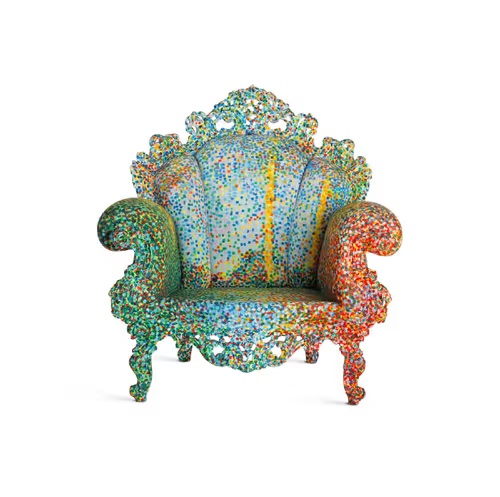
The Italian Alessandro Mendini ranks amongst the most important designers of the 1980s. In 1978, with the Poltrona di Proust lounge chair, Mendini programmatically began a furniture series of socalled “redesigns” in which he reinterpreted the shape and ornamentation of existing designs that were typical of their day. Two years previously, he had begun work on a fabric pattern for Cassina which was to be a reflection on French author Marcel Proust. While researching the upper-middle-class environment associated with Proust, Mendini came across a copy of a chair in the Neo-Baroque style. Inspired by this discovery, he expanded the fabric project to yield a furniture design. He covered the chair completely with a colorful, hand painted swarm of dots which reproduced an enlarged section of a Pointillist painting by Paul Signac. By equally painting all parts of the chair, irrespective of their structure and purpose, Mendini succeeds in citing not only Impressionism but also the Baroque, using the infinite as a central motif. Impressionist painting and the Baroque are imitated and trivialized in the pattern of the Poltrona di Proust, turning the chair into a flickering vision imbued with meaning. Classic design qualities such as originality, a functional construction, or cost-saving production are thereby fundamentally called into question. The lounge chair was originally conceived as the only one of its kind, but variations were later manufactured by Mendini’s studio as individual pieces or in limited editions.