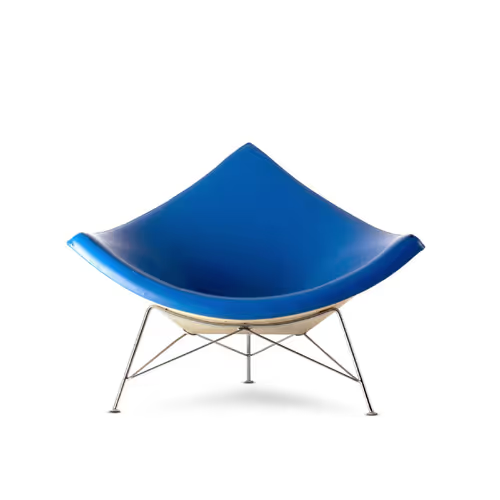
The name Coconut Chair, chosen by George Nelson for model No. 5596, evokes 1950s cocktail culture and was inspired by the lounge chair’s form. The seat shell’s shape as well as the colors used – a white shell and dark upholstery – are reminiscent of an inverted shard of coconut shell. Like the three germination pores in a coconut shell, the lounge chair’s shell rests on three legs. Designer George Mulhauser first introduced the idea for the chair at the Nelson office. Former employees of Nelson remember the design as part of the portfolio with which Mulhauser, a graduate of New York’s Pratt Institute, applied for a position in Nelson’s office. The Coconut Chair has a seat shell that integrates seat, backrest, and armrests into one element comprised of three layers. Until 1963, the outer shell was made using bent sheet steel. Since the chairs were likely to be used in company lobbies, where they would not be moved around, their weight was presumably of little consequence at first. The upholstery consisted of a layer of polyurethane foam. For the cover, leather and different fabrics are available, imitation leather was used between 1955 and 1978. Initially, the legs were welded to supporting struts to form the base frame of the chair. The same continuous piece of tubular steel that ran along the front edge of the seat shell also formed the two front legs. Due to production safety issues a new construction was introduced in 1963 where three single aluminium legs with rungs were joined by rivets. Shortly after the material used for the seat shells was changed from sheet steel to the considerably lighter fibreglass-reinforced polyester.