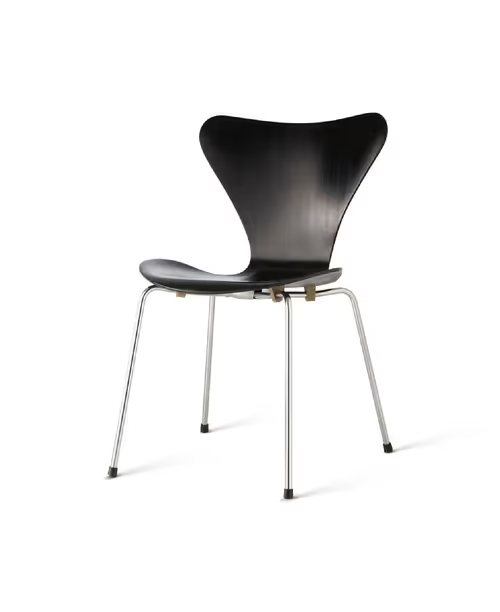
Four years after Arne Jacobsen had created the so-called Ant chair, Jacobsen in 1955 designed another plywood chair for Fritz Hansen, the chair No. 3107, also known as the Sevener. Its profile was distinctive, but less idiosyncratic than that of the Ant, making it more attractive to the masses and appropriate for a range of settings, such as private homes, public institutions or workplaces. It has a slightly larger seat shell with a slightly wider and taller back, on which one can rest an arm when sitting sideways. It is stackable and optionally available with brackets for setting up rows of chairs. The seat shell has no formal connection to its supporting structure: Thanks to their reflective surface, the chair’s slim legs create the illusion that the shell is floating in space like a sculpture. Sculptural qualities also result from the material used. The narrow waist was a necessity to allow the plywood to be bent three-dimensionally. The material also accounts for the seat shell’s slight springiness, which is enhanced by rubber inserts between the shell and the frame. Jacobsen’s innovative use of plywood was inspired by the designs of Charles and Ray Eames, whose chairs he had seen in the United States. The Sevener is the most successful of Jacobsen’s chair models and one of the world’s best-selling designer chairs. Since 1955 more than 7 million copies have been sold, and the model is considered to be one of the world’s most widely plagiarised chairs.