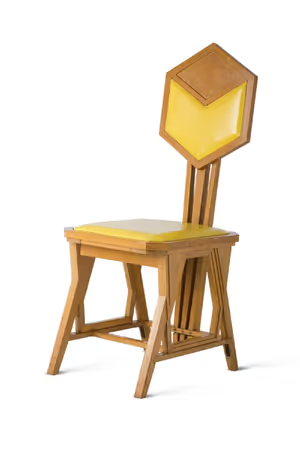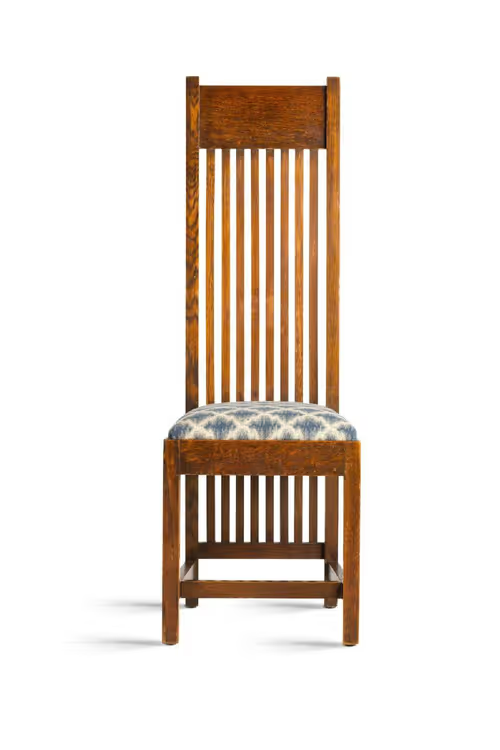
This chair was part of the interior for the Peter A. Beachy House, designed by Frank Lloyd Wright in 1906 on the foundations of its historicist predecessor in Oak Park, a suburb of Chicago. The house is one in the series of Prairie Houses which had earned Wright’s work international renown by 1900. In architectural history, these mostly luxurious single-family homes, usually also furnished according to Wright’s designs, mark an overcoming of the historicist style then prevalent. An emphasis on horizontal lines and flowing room sequences are defining features of this new style of house. The interior furnishings of the Peter A. Beachy House could only be preserved in part and no longer remain in their original location, like the high-backed chair shown here. This model is exemplary of a type of chair that Wright devised circa 1895 and repeatedly modified over the following decades. Seen in its historical context, the demonstrative simplicity of the chair’s clear, geometrical forms and its plain abandonment of historicizing embellishment are impressive. Yet the most striking feature of this type of chair, which was mainly used in the dining area, is its extra-high backrest, which consists of several vertical wooden slats. This design cannot be explained based on the primary function of seating furniture since it does not exactly contribute to a relaxed sitting position; rather its underlying motivation was conceptual. In an environment dominated – as Wright’s Prairie Houses are – by horizontal lines, these chairs constitute a carefully orchestrated vertical contrast. However, the spatial effect of these chairs is even more important than their visual appearance: arranged around a(dinner) table, they define a ‘space within a space’. This results in the creation of intimate islands in Wright’s often broad, open-plan room sequences.