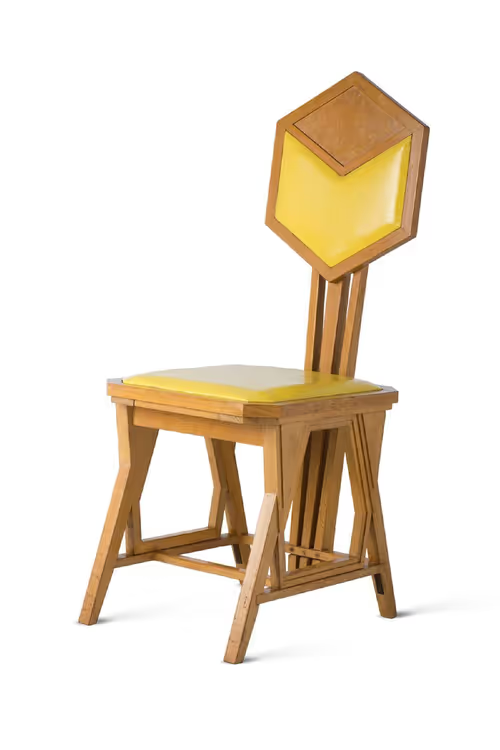
The Imperial Hotel in Tokyo, realized between 1917 and 1922, counts among the greatest accomplishments of Frank Lloyd Wright’s middle phase. His brief was not just to enlarge an existing hotel but also to design the interiors, including furniture, carpets, tableware, and silver. Among the furnishings, the so-called Peacock Chair with its hexagonal backrest was the piece that attracted the most attention. The chair – it probably had a dark blue covering originally1 – was used throughout the hotel complex. The design of the Peacock Chair reflects Wright’s play on geometrical forms. The hexagonal upholstered backrest, for example, is broken up into a rhombus at the top, which is fitted with a wooden panel. This purely aesthetic feature was intended to make the chair blend in better with its surroundings. The hexagonal motif of the backrest crops up again in the two side pieces, albeit slightly modified. The connecting piece between the backrest and stool is especially striking, taking the form of three slim wooden uprights that fan out slightly. It is above all these filigree connections that make this chair appear fragile. Some surmise that it ultimately proved inadequate to seat hotel guests of considerable height and girth,2 and there can be no doubt that here, Wright prioritized aesthetics over sturdiness. For him, the chance to create a Gesamtkunstwerk afforded by the contract for the Imperial Hotel had to be taken. The building complex was torn down in 1967.