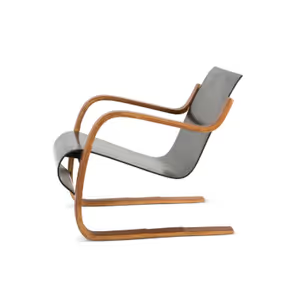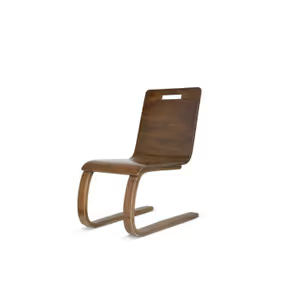
In 1929, Alvar Aalto won the design competition for the tuberculosis sanatorium in Paimio in southwest Finland. Construction began in April 1930, and in June 1933 the sanatorium, which Aalto had designed meticulously with patients’ needs in mind, was inaugurated. He also designed all the furniture and lighting and in April 1932, he displayed three of his furniture models at the Nordic Housing Fair in Helsinki, including a lounge chair, later known as the Paimio Chair. The design had a long developmental phase. Around 1931, Aalto began experimenting with laminated wood, aiming to create stable, organically shaped wooden frames for chairs. For the undulating framework of the Paimio Chair, several thin veneer layers were glued together and pressed into shape. One could then cut three or four chair frames, like slices, from one broad piece. Aalto arranged the veneered sections lengthwise in such a way that each one finished at a different point, making the frame appear seamless. The Paimio Chair’s curved seat shell is attached to the frame only at its top and bottom ends, which rest on overhangs strengthened by horizontal blocks. Because the seat shell forms a loop at both the top and bottom within the frame, it yields slightly under the weight of the sitting person, giving it a springy character that was quite popular at the time of the design.