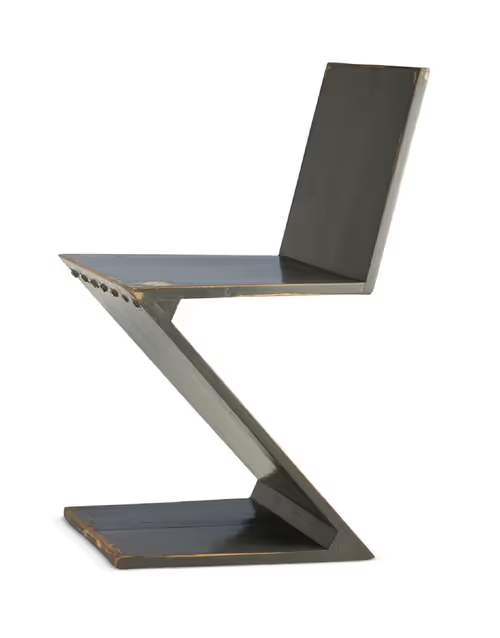
In 1932/33 the Dutch architect and furniture designer Gerrit Rietveld designed the famous Zig-Zag Chair. His original idea was to make a chair which could be mechanically produced by ‘folding’ a single piece of material. The actual execution proved to be more troublesome. In 1932, the Metz & Co. department store produced a version in tubular steel with a woven seat and back, but it lacked structural strength. Rietveld eventually resolved this problem by using four pinewood cupboard shelves which were connected with dovetail joints and brass screws and by stabilizing the construction with triangular wedges. Rietveld was obviously satisfied with the outcome: he included the Zig-Zag Chair in almost all his interior scale models. The chair was popular with customers too. Rietveld designed several one-off variants for private clients as well as several variations on the basic model for the Metz & Co. department store. The emphasis on the spatial aspect as well as the pursuit of mechanical production meant that the Zig-Zag Chair, which in terms of form is a variation on the cantilevered Freischwinger, accords with the Modernist school of thought. Although Rietveld did not succeed in folding the chair out of one piece of material, the form fits perfectly with his efforts to minimise the volumetric presence of furniture. More than twenty years later the Danish designer Verner Panton revisited this technical challenge and developed a chair that fulfils Rietveld’s basic principles: the Panton Chair.